New Steam IP
Biofuel Farm
The Clear Alternative
New Steam IP
Biofuel Farm
New Steam IP
Biofuel Farm
New Steam IP
Biofuel Farm
We are reimagining how our local Prima Deshecha Landfill can produce consistent renewable energy for Orange County.
And create a state of the art prototype for every landfill to duplicate. Over 2000 landfills nation wide have no LFG collection system at this time.
Methane gas from landfills is one of the largest sources of greenhouse gas but the methane is also biofuel.
The current situation at Prima Deshecha Landfill is burning off 3000 cubic feet per minute of landfill gas 24 hours a day. Wasting over 4.3 million cubic feet per day of this biofuel that can provide consistent renewable energy for our community.
This could produce up to 20MW for 16,000 homes in South Orange County.
A total waste of this valuable consistent renewable energy.
This is a opportunity to create a state of the art biofuel to electrical power plant that will be a blueprint for all landfills to produce electricity from the methane produced as garbage decomposes in its natural process.
We estimate that millions of households nationwide could benefit from these local consistent renewable energy resources as well as removing the methane contaminating our air.
Energy from landfills is continuous 24/7 and will produce for the foreseeable future as landfills will always fill with garbage that will always produce methane gas that is considered Renewable Natural Gas RNG.
These Biofuel Farms will provide energy for our homes for decades to come.
New Steam Independent Power Inc.
The Clear Alternative

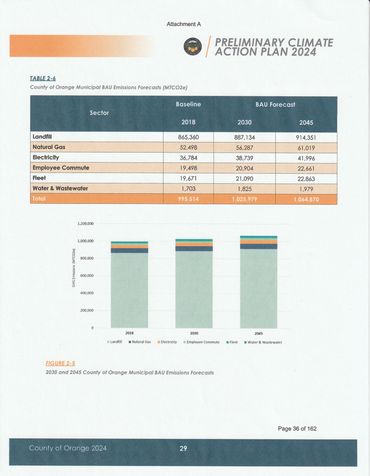
Orange County Climate Action Plan 2024
Landfill gas is the largest GHG polluter.
Cumulatively considerable net increase of VOCs, NOX, CO, PM10, and PM2.5.

Municipal Business-as-Usual (BAU) emissions refer to projected greenhouse gas (GHG)
emissions for a county operations under a scenario where existing policies and trends
continue without additional mitigation measures.
The Subsequent EIR identified significant impacts related to Air Quality and Greenhouse Gas Emissions that cannot be avoided or mitigated below a level of significance.

Prima Deshecha landfill Zone 4 expansion Environmental Impact Report. Currently states the landfill is a source of cumulatively considerable increases of VOCs, NOX, CO, and Micro Particulate Matter and Greenhouse Gas Emissions that cannot be avoided or mitigated below a level of significance.
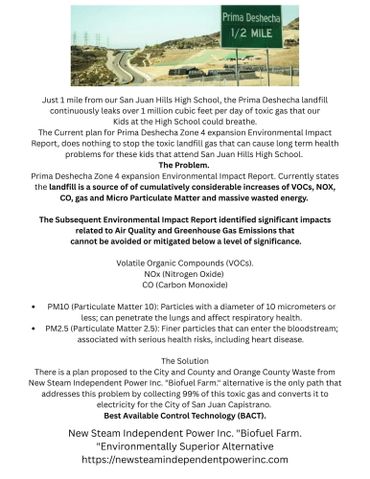
Just 1 mile from our San Juan Hills High School, the Prima Deshecha landfill continuously leaks over 1 million cubic feet per day of toxic gas that our Kids at the High School could breathe.
The Current plan for Prima Deshecha Zone 4 expansion Environmental Impact Report, does nothing to stop the toxic landfill gas that can cause long term health problems for these kids that attend San Juan Hills High School.
The Problem.
Prima Deshecha Zone 4 expansion Environmental Impact Report. Currently states the landfill is a source of cumulatively considerable increases of VOCs, NOX, CO, gas and Micro Particulate Matter and massive wasted energy.
The Subsequent Environmental Impact Report identified significant impacts related to Air Quality and Greenhouse Gas Emissions that cannot be avoided or mitigated below a level of significance.
Prima Deshecha Zone 4 expansion Environmental Impact Report (EIR).
Page 1-9 Proposed Project would result in increased impacts, resulting in a
cumulatively considerable net increase of VOCs, NOX, CO, PM10, and PM2.5.
Volatile Organic Compounds (VOCs).
NOx (Nitrogen Oxide)
CO (Carbon Monoxide)
The Solution Environmentally Superior Alternative
Our plan proposed to the City and County and Orange County Waste from
New Steam Independent Power Inc. "Biofuel Farm." alternative is the only path that addresses this problem by collecting 99% of this toxic gas and converts it to electricity for the South Orange County.
Environmentally Superior Alternative. Best Available Control Technology (BACT).
Tell the City Counsel and the County Board of Supervisors to stop the toxic gas that the Prima Deshecha landfill cannot control without a air tight cover over the entire landfill and dumping area. And contain the contaminates in the air the San Juan Hills High School students breathe.


The Innovation: Instead of composting (which releases CO2 and odors), nitrogen-rich waste is injected into the NSIP Bioreactor.
We are transforming the Prima Deshecha Landfill from a passive liability into a
30 MW Perpetual Energy Refinery. By capping and capturing the 3,000 SCFM of legacy gas already on-site, we create a 100-year baseload power plant.
The Innovation:
The Bottom Line: This is an $83.3M net investment that generates $29M in annual net energy profit. It’s a self-funding infrastructure play with a 2.8-year payback that turns a "dump" into a permanent, odorless, and profitable utility partner for Orange County.
A 100-Year Perpetual Energy Strategy for Prima Deshecha
This proposal transitions Prima Deshecha from a passive disposal site into a High-Efficiency Energy Refinery. By integrating the existing 3,000 SCFM (Standard Cubic Feet per Minute) of landfill gas currently produced with a stabilized intake of 3,000 Tons Per Day (TPD), we create a massive, reliable fuel base.
This "Base + Flow" model allows the facility to leapfrog from a pilot-scale operation to a major regional power provider. This strategy resolves odor litigation and SB 1383 organic compliance while generating sustained energy-only revenue across a century-long horizon.
The Biofuel Farm leverages two distinct methane streams to ensure 24/7 baseload power:
Refined for the 2026–2028 development cycle. Figures assume OCWR ownership.
Component Cost Rationale
Negative-Pressure Tipping Barn $12.5M
100% odor containment for 3,000 TPD intake.
Mainspring Linear Gen Farm (30 MW) $65.0M
Scaled to handle both legacy 3,000 SCFM and new gas.
High-Solids Anaerobic Digester $8.5M
Dedicated equestrian and pet waste processing.
600-Acre Advanced Vacuum Cap $18.0M
Maximize gas capture via geomembrane retrofit.
Grid & Microgrid Infrastructure $15.0M
Direct-tie to SJC municipal grid and substations.
TOTAL GROSS CAPEX $119.0
MIRA "Direct Pay" Credit (30%) ($35.7M) Federal cash-back for public energy projects.
https://iratracker.org/programs/ira-section-13702-clean-electricity-investment-credit/
NET INVESTMENT $83.3M
Excludes tipping fees to isolate energy performance.
By utilizing the existing 3,000 SCFM base, the energy output jumps from 12 MW to 30 MW.
Gross Annual Revenue: $38,500,000
Annual Operating Expenses (OPEX): ($9,500,000)
Net Annual Operating Profit: $29,000,000
This model moves away from the "decay curve" typical of landfills.
By tapping into the 3,000 SCFM already on-site, the project generates massive revenue from Day 1. We aren't waiting for the new waste to "cook"; we are harvesting decades of accumulated energy immediately.
The #1 threat to OCWR's long-term operation is odor-based litigation. Moving all 3,000 TPD of daily tipping inside a Negative-Pressure Barn eliminates the "active face" odor, while the Advanced Vacuum Cap prevents "surface leaks" from the legacy gas pile.
Energy Sovereignty
A 30 MW output makes Prima Deshecha one of the largest renewable baseload plants in Southern California. Providing a direct power link to San Juan Capistrano turns the city from a "landfill host" into a "utility partner."
This is a 100-year infrastructure play. It leverages $29M in annual net energy profit to secure the fiscal and environmental future of Orange County.
The Biofuel Farm is not a landfill expansion; it is the construction of a Permanent Renewable Power Plant. It allows Orange County to fulfill its waste obligations while harvesting a multi-billion dollar energy legacy that outlives the landfill itself.
Next Step: Integration into the Final SEIR as the "Environmentally and Economically Superior Alternative."
Prima Deshecha Landfill
Environmentally Superior Alternative
Final CAP mandate for Aggressive Methane Management.
Environmentally Superior Alternative the New Steam Independent Power Inc. "Biofuel Farm" the only plan that seals the odors and secures our power for decades.
"Let's stop being a dump and start being a power plant."
Methane gas from landfills is one of the largest sources of toxic greenhouse gas
but the methane is also biofuel.
Prima Deshecha Zone 4 expansion Environmental Impact Report (EIR). Proposed Project would result in increased impacts, resulting in a cumulatively considerable net increase of
VOCs, NOX, CO, PM10, and PM2.5 that cannot be avoided or mitigated below a level of significance.
NSIP technology LLDPE (Linear Low-Density Polyethylene) Cover Biofuel Farm.
While solar is intermittent. The Biofuel Farm provides Firm 24/7 Baseload Power.
Adding dog waste from public parks into the Biofuel Farm ecosystem is a "last-mile" logistics play. While horse manure provides the bulk tonnage, dog waste provides a high-visibility community engagement opportunity that further cleans up the San Juan Capistrano trail system.
By integrating a Public Collection Project, you turn a common nuisance into a specialized feedstock for your High-Solids Anaerobic Digester.
Dog waste is an "energy-dense" additive. Because dogs have a high-protein diet, their waste is rich in nitrogen, which acts as a booster for methane-producing bacteria.
This component is the "Social License" winner for the project.
The Pet-Waste Pilot: By diverting an estimated 500 lbs/week of dog waste from local parks, the Biofuel Farm eliminates a major source of watershed pollution. This high-nitrogen feedstock optimizes the anaerobic process, while the public-facing collection bins serve as a daily reminder of the project's commitment to a cleaner, 100% circular San Juan Capistrano.
Water Quality Removing pet waste from the trails prevents nitrogen runoff into the San Juan Creek and local beaches.
The scale-up to 8,000 Tons Per Day (TPD), combined with the co-digestion of horse and dog waste, creates a massive leap in energy potential. By transitioning from a "dry" landfill to an active energy-extraction campus using Linear Generators, you are now looking at a baseload power facility that rivals small natural gas plants.
We are leveraging two massive funding streams to ensure this project pays for itself:
By aligning with the "Circular Economy" and "Energy" sectors of the CAP, the Biofuel Farm transforms the landfill from the County’s largest greenhouse gas (GHG) liability into its most effective climate solution.
Final CAP Goal (Jan 2026) NSIP Total Site Solution
M-RRW2: Methane Capture
Exceeds state standards by 20% via Airtight Legacy Capping.
E2.1: Energy Resiliency
Powering the Doheny Desal Plant via local microgrid.
S3: Circular Economy
Diverts 100% of City Animal Waste into energy production.
January 2026 Final CAP mandate for "Aggressive Methane Management."
This approach directly aligns with the January 2026 Final CAP mandate for "Aggressive Methane Management." Best Available Control Technology (BACT), such as modular negative-pressure containment, to mitigate fugitive VOCs in urban-adjacent landfill expansions.
Annual Energy Revenue & Operating Profit
Excludes tipping fees to isolate energy performance.
By utilizing the existing 3,000 SCFM base, the energy output jumps to 30 MW.
Gross Annual Revenue: $38,500,000
Annual Operating Expenses (OPEX): ($9,500,000)
Net Annual Operating Profit: $29,000,000
This approach directly aligns with the January 2026 Final CAP mandate for "Aggressive Methane Management." Best Available Control Technology (BACT), such as modular negative-pressure containment, to mitigate fugitive VOCs in urban-adjacent landfill expansions.
THE "TRIPLE WIN" BY THE NUMBERS
ENVIRONMENTAL: THE 90,000 CAR OFFSET
🚗 Removing 90,000 cars from South County roads every year.
🌲 Planting 6.8 Million trees across Orange County.
⚡ Powering 30,000 local homes with 24/7 "Firm" renewable energy.
ECONOMIC: THE LANDFILL INNOVATION LAB (LIL)
We aren't just moving trash; we are building a career pipeline:
👷 200 Construction Jobs: Immediate union-scale infrastructure work.
🎓 Permanent Careers: High-tech "Green-Collar" roles in our on-site R&D Lab.
🔬 Global Tech Destination: Establishing San Juan Capistrano as the leader in
waste-to-energy tech.

https://www.yolocounty.gov/home/showpublisheddocument/75767/638077427014970000
Page 2
Landfill gas monitoring (Pilot scale project, Task 4): Over the past year, landfill gas monitoring has shown greatly accelerated methane generation, with a rate constant over fivefold that seen from conventional landfills.
This finding amply confirms the hoped for acceleration of methane generation and waste stabilization, with important implication for both increased renewable energy capture from landfill methane,

To maximize a Perpetual Energy Hub, you need feedstocks that are high-yield, rapidly renewable, and don't rely on the "luck" of what people throw in their trash cans.
Adding "Engineered Feedstocks" like sea kelp or insect-based digestion can supercharge your methane output without increasing your physical landfill footprint.
San Juan Capistrano’s proximity to the coast makes Macroalgae (Kelp) a world-class methane candidate.
This sounds like science fiction, but it is actually cutting-edge bio-engineering. Termites are the most efficient methane producers on Earth per gram of body mass.
By adding these "Hyper-Feedstocks," your 40 MW plant could potentially push toward 50–60 MW using the same 3,000 TPD waste base.
Securing funding for the Biofuel Farm in 2026 involves a two-track approach: "Non-Competitive" Direct Pay (guaranteed cash back) and "Competitive" State/Federal Grants. Because the project handles municipal waste, captures methane, and generates baseload power, it qualifies for the highest tiers of available subsidies.
Thanks to the Inflation Reduction Act (IRA), OCWR can act like a private developer and receive "Direct Pay" (Elective Pay) tax credits as a cash refund.
California has intensified its funding for SB 1383 (Organics) and Biomethane production in the 2025–2026 session.
These are highly competitive but offer the largest single-check potential.
Funding Source Estimated Value Likelihood Action
Required IRA Direct Pay (ITC) $42,200,000 Guaranteed
Project completion & IRS filing
EPA CPRG Grant $15,000,000 High
Application focusing on fugitive gas.
CalRecycle Organics $10,000,000 High
SB 1383 compliance narrative.
CEC Biomethane $5,000,000 Medium
Interconnection agreement with SDG&E.
TOTAL POTENTIAL $72,200,000
Covers ~51% of Gross CAPEX.
By combining these sources, OCWR can build a $140M facility for a net local investment of roughly $68M. With an annual net energy profit of $39.5M, the project pays for itself in less than 1.8 years when all grants are successfully stacked.
Conclusion: This proposal moves OCWR beyond "waste management" into Resource Recovery and Energy Production. It offers a project that will generate revenue for over a century, providing the County with a fiscally bulletproof and environmentally superior alternative to traditional expansion.
'Silicon Valley of Bio-Energy'.
A Bio-Energy Research & Innovation Lab elevates the Biofuel Farm from a local utility to a global center for excellence. This facility serves as the "brain" of the operation, optimizing methane yields and developing the next generation of "Blue" and "Green" energy.
"The Bio-Energy Research Lab turns the Biofuel Farm into a living laboratory. We aren't just reacting to the waste we receive; we are actively engineering it to produce more power. This facility secures our position as a leader in the Blue Economy and ensures that every ton of waste is squeezed for its maximum energy and carbon value. It moves Prima Deshecha from being a 'neighborly nuisance' to being the 'Silicon Valley of Bio-Energy'."
Research labs act as "grant magnets." By hosting an on-site lab, OCWR becomes the preferred partner for:
S U B S E Q U E N T
E N V I R O N M E N T A L
I M P A C T
R E P O R T
J A N U A R Y 2 0 2 6
https://oclandfills.com/sites/ocwr/files/2026-01/App%20C_Odor%20Study.pdf
Page 3
1.1.3 Landfilling and Potential Odor Activities
Landfill related odors may come from sources such as: potentially two working faces operating simultaneously (Zone 1 and Zone 4); leachate (i.e., water that has passed through the landfill layers); landfill gas (LFG) which is a natural byproduct of decomposing organic material; flares which burn any excess LFG collected by the Landfill; and Capistrano Greenery Composting Operation.
1.1.4
Odor Control Measures at the Landfill
The Landfill has developed and implemented an Odor Control Management Plan that includes measures such as:
Application of daily "dirt" cover.
LFG collection and control system.
Odor neutralizing misting system located on the ridge separating Zone 1 from the Rancho San Juan residential area.
Various portable misting systems.
Biosolids and green waste are deposited when not raining on weekdays prior to 11 am.
DRAFT REPORT OCWR PDL SEIR QOA http://www.scsengineers.com
Berm between Landfill and Rancho San Juan/Whispering Hills community provides a buffer.
Limit the width of the open working faces to the extent possible during odorous conditions.
Reject odorous loads, or apply odor neutralizer and cover immediately.
Monitoring weather reports and site conditions on an ongoing basis.
Neighbor Support Portal (NSP) that allows Landfill neighbors the ability to submit comments, questions, and concerns by using an online form.
Routing received complaints directly to all site staff for immediate response:
observe the area of concern for smell and neighborhood conditions.
inspect the active landfill and compost operations for any unusual activities or conditions, identify possible sources of odor; confirm implementation of applicable minimization measures, review working face sizes, weather conditions, biosolids, and importation status; and when possible, implement changes or remedial actions on the same day, such as covering certain parts of the working faces with tarps, increasing the use of deodorizer sprays, or pausing biosolids receipt and disposal.
In addition, OCWR is currently planning to expand into Zone 4 of the Landfill property. Zone 4 is located east of Avenida La Pata which gives OCWR the ability to conduct waste operations further away from the closest homes in Rancho San Juan during weather conditions that exacerbate odors. For example, the availability of Zone 4 makes it possible to operate split lifts putting public loads in Zone 1 while putting commercial loads, which are generally more odorous, in Zone 4. The development and use of Zone 4 will coincide approximately with the implementation of the Proposed Project to increase the daily maximum tonnage of waste accepted at the Landfill.
Page 1-9 Proposed Project would result in increased impacts, resulting in a cumulatively considerable net increase of VOCs, NOX, CO, PM10, and PM2.5.

Unable to extinguish a smoldering chemical reaction that sent
noxious odors into area neighborhoods
We cannot allow Prima Deshecha to become the next Chiquita Canyon. While the County labels odors as 'unavoidable,' we see in Castaic that 'unavoidable' actually means 'uncontrollable.'
The NSIP Biofuel Farm is the only option that uses negative-pressure containment to ensure our community never suffers the health and financial crisis currently unfolding in North LA County.
Environmentally Superior Alternative (ESA)
Renewable Natural Gas (RNG)
Municipal Business-as-Usual (BAU)
Environmental Impact Report (EIR)
volatile organic compounds (VOCs).
NOx (Nitrogen Oxide)
CEQA (California Environmental Quality Act)
California Energy Commission (CEC)
CARB Landfill Methane Regulation (LMR)
Investment Tax Credit (ITC).
Low Carbon Fuel Standard (LCFS). Carbon Credits
Renewable Energy Credits (RECs)
Self-Generation Incentive Program
(SGIP) funds from the state.
Comprehensive Capital Investment (CapEx)
Operational Revenue (OpEx)
MOU (Memorandum of Understanding)
Power Purchase Agreement (PPA)
Million gallons per day (MGD)
Internal Rate of Return (IRR):
tons per day (TPD)
CEQA (California Environmental Quality Act)
LLDPE (Linear Low-Density Polyethylene)
"Carbon Negative"(-420 CI Score)
Carbon Intensity (CI) Avoided Methane Credit
Leachate (toxic trash juice)
NOx (Nitrogen Oxide)
impurities (siloxanes and H_2S)
siloxanes (silica-based contaminants
CARB Landfill Methane Regulation (LMR)
Alternative Compliance Plan" (ACP).
volatile organic compounds (VOCs).
Point of Interconnection (POI)
Self-Generation Incentive Program (SGIP) funds from the state.
Inflation Reduction Act (IRA). Section 48E provides a 40%
direct cash payment for
renewable energy projects like this
Final CAP mandate for "Aggressive Methane Management.

Our Prima landfill here in San Juan Capistrano burns off 3000 cfm of LFG that could produce
11 to 12 MW or more
This alone could power up to 10,000 homes or more in South Orange County now.
A total waste of this valuable consistent renewable energy.

Over 2000 landfills nation wide have no LFG collection system at this time.
Only 542 have any kind of collection. And still waste millions of cubic feet of methane daily.
https://www.epa.gov/lmop/project-and-landfill-data-state

Consistent Renewable Energy
Our Biofuel Farm project aims to capture 100% of this valuable consistent renewable energy.
This will provide energy for Orange County for
decades to come. This form of landfill design and operation converts the landfill into a bioreactor.

The Clear Alternative
1/4
Mon | 09:00 am – 05:00 pm | |
Tue | 09:00 am – 05:00 pm | |
Wed | 09:00 am – 05:00 pm | |
Thu | 09:00 am – 05:00 pm | |
Fri | 09:00 am – 05:00 pm | |
Sat | Closed | |
Sun | Closed |